Clay vs. Drevon: Data Enrichment vs. Intent Discovery
Two Approaches to Prospecting
Clay and Drevon are often compared, but we solve different go-to-market problems. Clay is a workflow builder for enriching existing data lists. We designed Drevon as an AI agent for discovering new prospects based on real-time intent. The choice is between two distinct philosophies for finding customers.
Clay operates like a spreadsheet with API access. You bring a list of prospects, and Clay helps you build a 'waterfall' to add columns of information to it by chaining together data from over 150 providers. We built Drevon to operate like a research assistant. You give it a task in plain English, and our agent builds a list for you by browsing public sources for timely buying signals.
This post compares the core mechanics, ideal use cases, and trajectory of these two approaches.
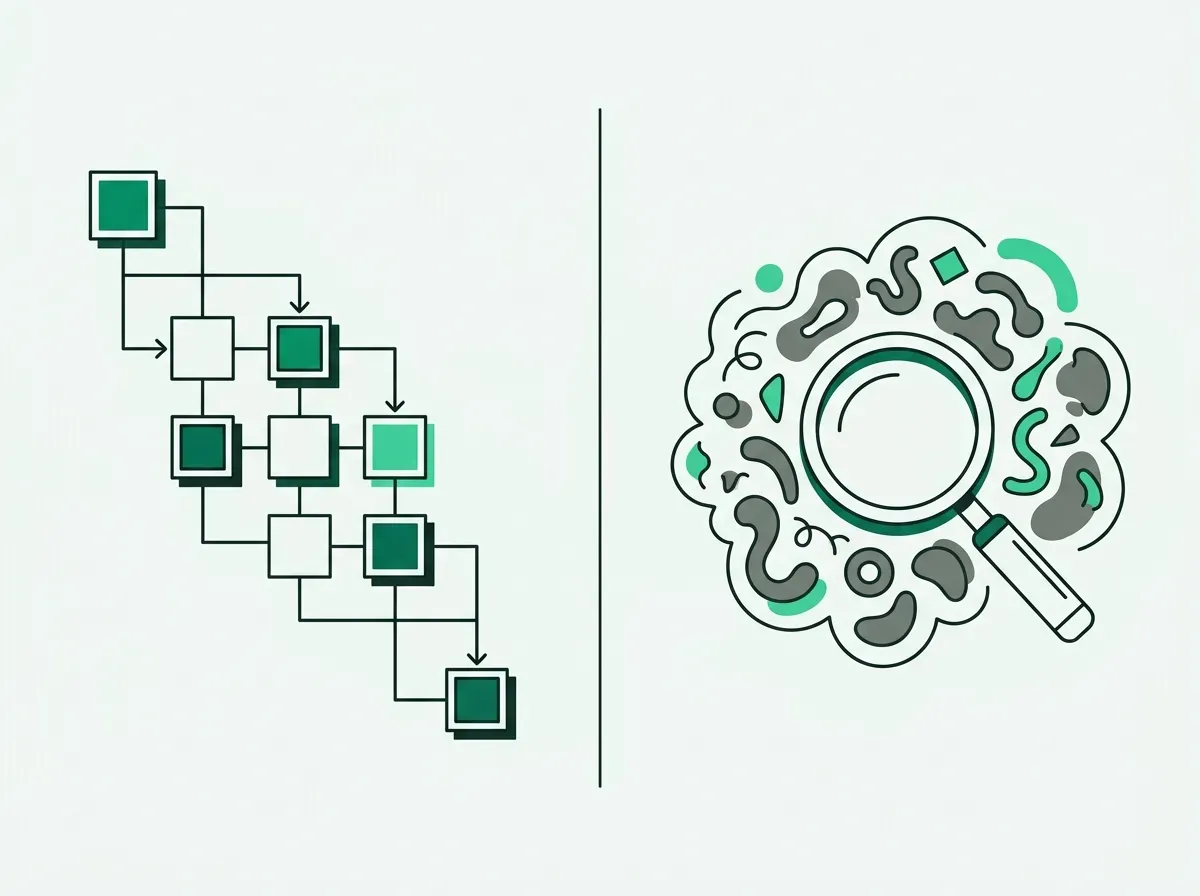
Core Philosophy: Data Enrichment vs. Intent Discovery
Clay’s model is built for data enrichment. Its primary function is to take a static list and augment it with structured data points. This is effective for tasks like finding the technology stack for 1,000 company domains or verifying emails for a conference attendee list.
This workflow-based approach has limitations. The user is responsible for building and maintaining the logic. This leads to a steep learning curve; a March 2026 review from the advisory firm SyncGTM notes that users should "Expect 4-6 weeks of dedicated onboarding." The platform’s complexity and pricing model make it most effective for technical users. Clay uses a dual-credit system for platform actions and data enrichments that can make costs difficult to forecast, especially when running complex 'waterfall' workflows.
We built Drevon’s model for intent discovery. Our agent interprets a natural language prompt and executes a dynamic research plan. It browses sources like LinkedIn, Reddit, and company websites to find prospects demonstrating a specific need. This is designed for discovery tasks, such as 'find me 50 companies that just hired a VP of Engineering and are posting about scaling issues.'
This agent-based approach finds signals that cannot be captured in a structured API call. For example, a prospect posting on Reddit, “We need to switch from [Competitor Tool] by Q2... our budget is around $5K/month.” This is declared intent, providing context, budget, and a timeline that firmographic data providers cannot see.

A Practical Comparison
The right tool depends on your starting point and your goal.
Use Clay When You Have a List
If you already have a list of companies or contacts and need to add specific data points, Clay is the more direct tool. You can build a workflow to process your list and enrich each entry systematically.
A typical Clay task looks like this:
For this list of 500 company domains, find their employee count from LinkedIn, funding amount from Crunchbase, and check if they use HubSpot.
To execute this, you set up a multi-step workflow, connect the necessary data providers, and run your list through it. This consumes credits for both platform usage and data provider lookups.
Use Drevon When You Have a Hypothesis
If you have a theory about who your best customers are and need to find them, Drevon is the more direct tool. You can give our agent a prompt that describes your ideal customer based on their recent activity.
A typical Drevon task looks like this:
Find product managers on Reddit complaining about their current analytics tools and list their companies.
Drevon performs the research to find these individuals and generates the list for you. We focus on discovering prospects based on context that signals an active need, rather than enriching a list of static targets.
The Outlook: Why Agents Outpace Workflows
The value in go-to-market is shifting from raw data to contextual insight. While the market for data monetization is growing, the value of isolated, commodity data points is diminishing. A 2025 academic analysis of sell-side analyst reports found that the raw 'Financial Analysis' section contributed only 16% to a report's investment value, while the 'Strategic Outlook'—the interpretation and context—accounted for 41%. The durable advantage is finding timely intent, not just enriching static lists.
Workflow tools are powerful but brittle. They require constant maintenance as APIs change and data sources degrade, and the user bears the burden of building and troubleshooting the logic. This time investment is significant. GTM automation consultancies publish guides detailing six-to-eight-week timelines for implementing production-ready sales workflows, covering everything from data cleaning to full rollout.
AI agents, in contrast, are designed to handle the ambiguity of the open web and adapt their research strategy. The pace of improvement is rapid. When the OS-World benchmark for real-world computer tasks was introduced in April 2024, the top AI agent achieved a success rate of just 12.24%, far below the human baseline of 72.36%. Today, leading agents on the public leaderboard score over 85%, demonstrating a fundamental shift in their ability to execute complex, multi-step tasks.

Conclusion: Choose the Right Tool for the Job
Clay is a tool for data engineers and technical marketers to enrich known lists. We built Drevon as an AI agent for growth teams to discover new customers.
If your primary task is augmenting existing data sets with structured information, Clay is a strong choice. If you need to find new prospects based on timely, context-rich intent signals, Drevon is the more direct path.
You can start using Drevon to find customers today.