Credit-Based Pricing Models Penalize Discovery
Pricing models are product features. When a growth tool charges per search or per lead, it fundamentally changes how you use it, often for the worse. This per-credit model creates a scarcity mindset that penalizes exploration and leads to lower-quality results.
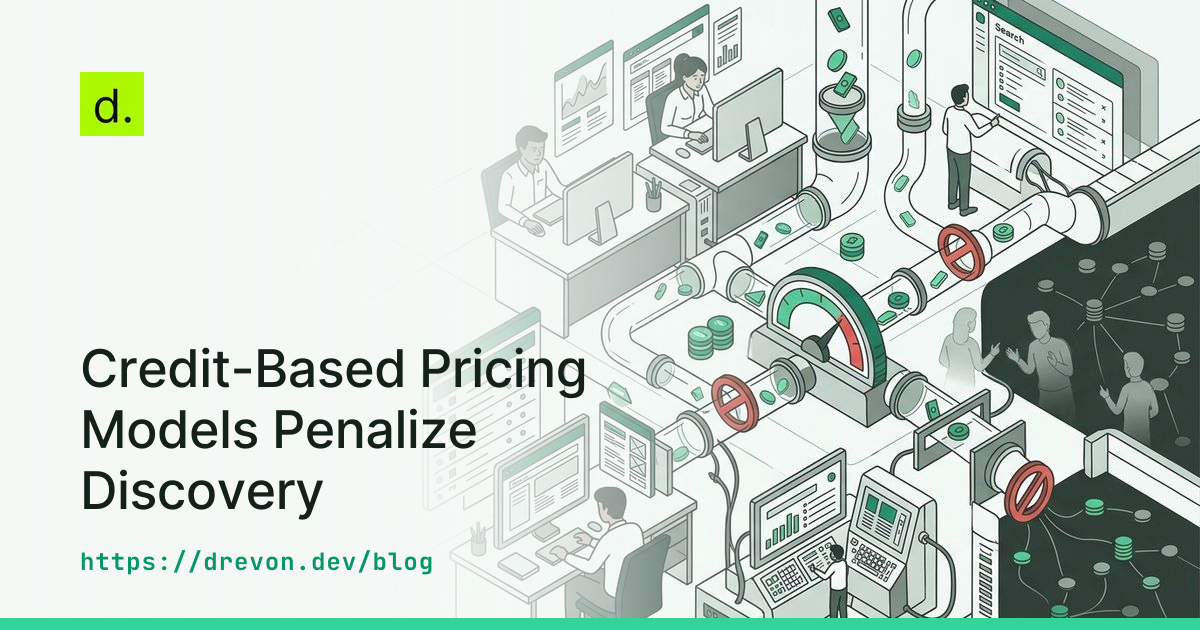
Most data and prospecting tools charge per unit of value. One credit might equal one email reveal, one company export, or one search query. This is a common way to align price with usage. But it transforms the process of research from fluid exploration into a series of metered transactions. Each click has a cost, however small.
This design decision triggers a well-documented psychological principle: loss aversion. First identified by psychologists Daniel Kahneman and Amos Tversky, loss aversion describes our tendency to feel the pain of a loss about twice as powerfully as the pleasure of an equivalent gain. When each credit spent feels like a small loss, users naturally begin to ration their activity to avoid waste. This changes their behavior in predictable ways.
The Second-Order Effects of Scarcity
When exploration is expensive, users adapt their workflow to minimize cost. This leads to three behaviors that degrade the quality of their research.

1. Users Over-Filter Upfront
To guarantee a return on a credit, users apply rigid, narrow filters from the start. They act as if they already know exactly what their ideal customer profile looks like. This behavior is a reaction to the “paradox of choice,” a term coined by psychologist Barry Schwartz. Faced with dozens of filters and a cost for using them, users try to find the single best answer in one perfect query. This is especially true for what Schwartz calls “maximizers,” who feel compelled to make the absolute best choice. The result is often a search that is too restrictive, yielding a small list of obvious leads or no results at all.
2. Iterative Discovery Becomes Too Expensive
Good research is iterative. It involves starting with a broad hypothesis, learning from the initial results, and then refining the search. A credit model makes this process costly. Each exploratory “what if” query depletes a user’s budget, discouraging the very process that leads to insight. Research from the Nielsen Norman Group found that iterative design improves the usability of a system by a median of 165%. Similarly, a 2021 study by researchers from Stanford University and LinkedIn found that an iterative approach to experimentation led to an additional 20% improvement in one of the company's primary metrics. By penalizing iteration, credit models leave these gains on the table.
3. Flawed Hypotheses Go Unchallenged
If a team has a specific idea of their ideal customer, a credit model encourages them to stick with it. Running searches for adjacent or alternative customer profiles feels wasteful. This is a critical error. For example, a 2024 case study of a Brazilian construction materials supplier found that implementing a custom data model for credit sales increased net profit by 124.2%. This kind of discovery is only possible through broad, exploratory analysis—the exact behavior that credit models disincentivize.
The True Cost: Missed Opportunities
The primary cost of a scarcity mindset is not the money spent on credits, but the opportunities left undiscovered. The best leads are often found just outside the bounds of a perfectly-defined filter. When users are afraid to explore, they default to the safest, most obvious search parameters. This leads them to the same over-contacted prospects as everyone else.
This frustration is common among growth marketers. Public discussions describe how credit limits interrupt workflows and punish the most active users. On some platforms, wasted credits on bounced emails from cold outreach or old lists can reach 10-15%, a figure supported by market analyses which show average bounce rates for such campaigns at 10.68%.
This is observable even on powerful platforms like LinkedIn Sales Navigator, which offers over 40 advanced filters. According to a guide from GiveMeLeads, most users apply only five or six. Another analysis noted that many teams use “maybe 3 filters,” leveraging just a fraction of the tool's capability. They are conditioned to narrow their focus from the start, which creates false negatives. A search with zero results does not always mean the leads do not exist; it often means the user’s credit-saving filters were too restrictive.

Pricing for Exploration
A pricing model is a core part of the user experience. It sets the terms of engagement with the product and dictates the user's behavior. The price of a credit at a major provider can be as high as $2.99, while others are closer to $0.20. Regardless of the price, the transactional nature remains.
We designed our model to remove the cost of curiosity. When exploration is not penalized, users can run the extra query that uncovers a new market or a better customer profile. The goal is to encourage broad, iterative searches that lead to non-obvious targets. This is how genuine discovery happens.
You can try Drevon to see how an unlimited model changes the research process. Start with a broad query and follow where the results lead.