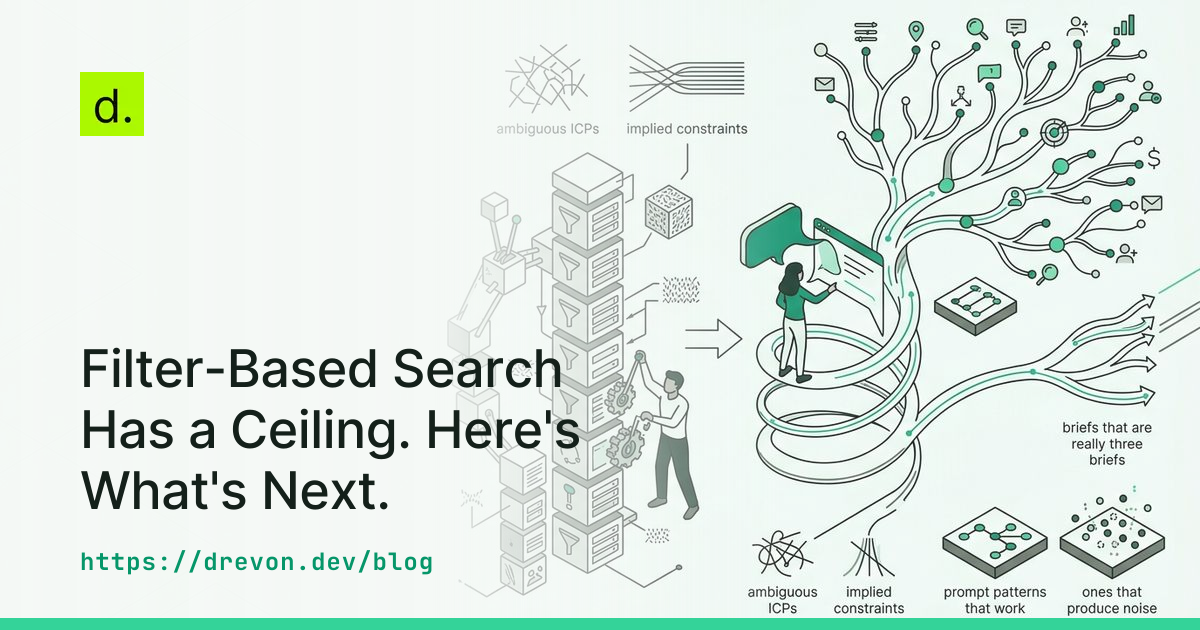
Filter-Based Search Has a Ceiling. Here's What's Next.
The Ceiling of Filter-Based Search
Most prospecting tools are built around a filter-based UI. Users are presented with a long panel of dropdowns and text fields to define a search for leads or accounts. This model is familiar, but it has a low ceiling. It breaks down when GTM teams need to find prospects based on nuanced, multi-part buying signals.
These tools force you to search for static attributes like industry, company size, and location. Leading platforms offer dozens of options; LinkedIn Sales Navigator has over 40 filters and Apollo.io has more than 50. This complexity creates significant cognitive load. Research from the Baymard Institute shows that sites with mediocre filter usability see user abandonment rates as high as 90%. The interface itself becomes a bottleneck.
The more critical limitation is that filters cannot express dynamic events or intent. A modern GTM motion might target companies that fit a firmographic profile, just experienced a trigger event, and are actively signaling a specific pain point. For example, a query like, “Find me B2B SaaS companies where a developer on Reddit is complaining about their code review process and the company’s career page lists new openings for Senior Software Engineers,” is impossible to build with dropdowns. You cannot combine signals from disparate public sources. Even within a single platform like HubSpot, you cannot apply “OR” logic between different filter groups, forcing users to create and manage multiple lists for what should be a single segment.

How Natural Language Captures Complex Intent
We built Drevon around plain-English briefs to overcome this ceiling. A brief allows you to describe your target customer using the same language you would use to instruct a human research assistant. This shifts the cognitive work from manually combining dozens of filters to simply stating the desired outcome.
An effective brief might look like this:
Find me 25 SaaS companies in the US with 50-200 employees that have raised a Series B in the last 12 months and currently have open roles for a Head of Product.
This works because it specifies three distinct types of qualification criteria in a single instruction:
- Company Attributes: SaaS, US, 50-200 employees
- Trigger Event: Raised a Series B in the last 12 months
- Intent Signal: Currently hiring a Head of Product
This approach is part of a broader shift in enterprise software toward conversational interfaces. Analyst firms predict this will become the default way users interact with data. Gartner forecasts that by 2026, 40% of enterprise applications will be integrated with task-specific AI agents. The need for this shift is clear when looking at the limitations of existing tools. For years, the adoption of traditional BI and analytics platforms has remained low. A global survey by BARC and Eckerson Group found that, on average, only 25% of employees actively use their company's BI tools. The complexity of these platforms creates a barrier for non-technical users. Natural language interfaces directly address this problem. For example, after deploying a natural language chatbot for its business intelligence platform, JPMorgan Chase saw a 40% reduction in the time executives spent on data analysis.
Where Briefs Break: Common Failure Modes
Natural language is more powerful than filters, but it is not magic. The quality of the output depends directly on the quality of the input. After analyzing thousands of briefs run through Drevon, we have identified three common failure patterns that produce noisy or irrelevant results.

1. The Ambiguous Brief
A prompt like, “Find me some good tech startups,” contains no useful information. The terms “good” and “tech startup” are not defined. The agent is forced to guess, and its guesses will be wrong. This brief will produce a list of random companies.
- The Fix: Add specific, verifiable constraints. A better version would be, “Find me 15 B2B SaaS startups that have raised a seed round of over $2M in the last 9 months and use HubSpot and Intercom on their website.”
2. The Implied Constraint Brief
A user might write, “Find companies hiring salespeople.” The agent will search for job titles containing the word “salespeople.” It will miss roles like “Account Executive,” “Business Development Rep,” or “Sales Director.” The agent does not know your company’s internal jargon or the specific roles that map to your ICP.
- The Fix: Be explicit about what you mean. The corrected brief would be, “Find companies with open roles for ‘Account Executive’ or ‘Business Development Representative’.”
3. The Compound Brief
A request for, “fintechs struggling with compliance and e-commerce brands looking for new logistics partners,” is two different searches. Combining them into a single brief confuses the agent’s focus and dilutes the results. You will get a mixed list of leads that satisfies neither criterion well.
- The Fix: Split the request into two focused briefs. Run one search for the fintech ICP and a separate search for the e-commerce ICP.
A Simple Framework for Writing Better Briefs
To get accurate results from a natural language agent, your instructions must be clear. We advise our users to structure briefs around a simple framework: be Specific, Explicit, and Singular.
- Specific: Use numbers and proper nouns. Instead of “recently funded,” use “raised a Series A in the last 6 months.” Instead of “uses marketing automation,” use “has the Marketo tracking script on their website.”
- Explicit: Do not assume the agent knows your internal context. Instead of “hiring for our ICP,” list the exact job titles you target, like “currently hiring for ‘VP of Engineering’ or ‘Director of Infrastructure’.”
- Singular: Focus each brief on one ideal customer profile. If you sell to two different personas with different pain points, create two different briefs.
These principles align with best practices for prompt engineering from AI research labs like OpenAI and Anthropic, which emphasize clarity, task decomposition, and providing specific context to guide the model’s output.

From Filters to Instructions
Natural language offers more precision and power than a wall of filters, but it requires you to be precise in your instructions. The system is only as good as the questions you ask it.
To see this in practice, take one of your existing ICPs and try to write it out as a single, plain-English paragraph using the Specific, Explicit, and Singular framework. The exercise often reveals the hidden assumptions and ambiguities in a team’s targeting. It is the first step toward a more effective way of prospecting.