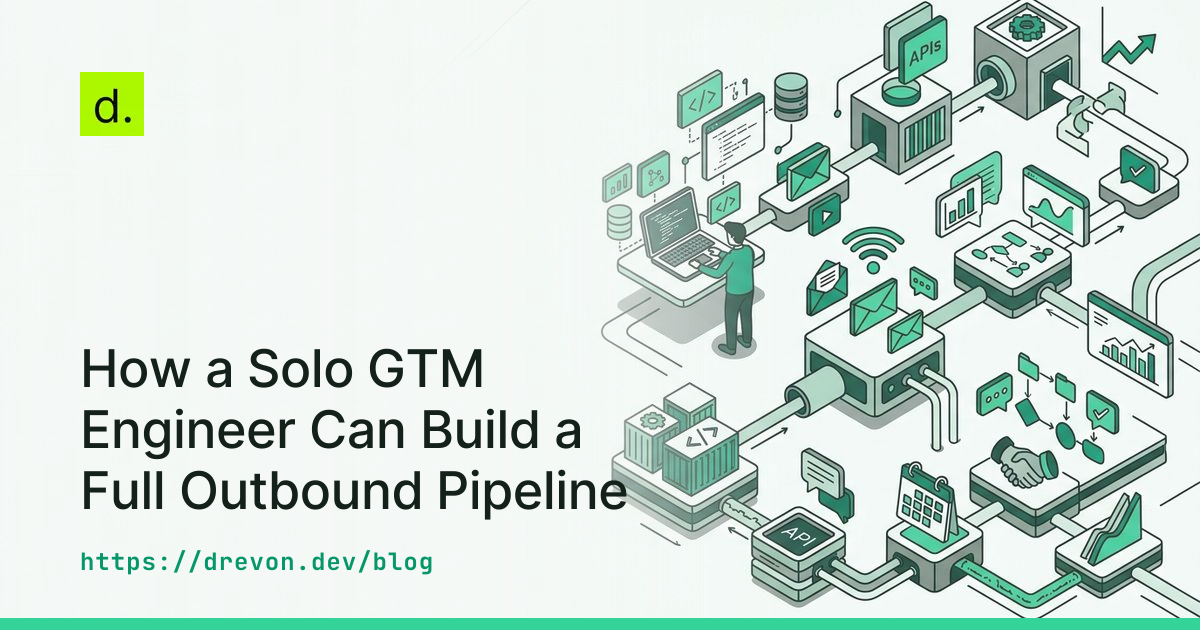
How a Solo GTM Engineer Can Build a Full Outbound Pipeline
Beyond the Lead List
Outbound marketing is often treated as a brute-force game requiring large teams. We find this is no longer true. A single Go-to-Market (GTM) Engineer can now architect and operate a complete system for discovering signals, enriching leads, and initiating personalized outreach at scale.
This is not about working harder; it is about building a better machine. This post provides a framework for building this engine, from defining your target signals to measuring pipeline contribution.
The Solo Operator's Stack
The goal is a minimal, highly integrated toolset, not a sprawling martech stack. A functional engine can be assembled for a monthly cost between $0 and $150. Setup for the core components can be done in a single business day.
The stack has four core components:
- A prospecting agent: An AI assistant like Drevon to find companies and contacts based on real-time signals.
- A CRM: A central database to store and manage leads, such as Attio, HubSpot, or Pipedrive.
- A data enrichment source: A tool like Clearbit or Apollo.io to add context to your leads.
- An outreach tool: A platform like Clay or Outreach to execute automated sequences.
These components connect in a logical flow. The agent finds leads with proven intent, the CRM organizes them, enrichment adds depth, and the outreach tool begins the conversation.

Step 1: Isolate High-Intent Signals, Not Just Titles
Traditional Ideal Customer Profiles (ICPs) based on firmographics like company size or industry are insufficient. They produce noisy lists that lead to low-quality outreach. Instead, we focus on 'trigger events' or buying signals that indicate a specific, timely need.
These signals go beyond recent funding rounds or key hires. They can include:
- Technology stack changes: A prospect adds a complementary technology or, more importantly, drops a competitor's product.
- Mergers and acquisitions: M&A activity creates a near-certain need to re-evaluate and consolidate software stacks.
- Negative competitor reviews: A prospect publicly voices a pain point that your product solves.
- Geographic expansion: A company opens an office in a new region, creating needs for new operational tools and services.
The target shifts from 'Series A tech companies' to 'Series A tech companies that just hired their first VP of Sales and are posting jobs for SDRs.' This precision is the foundation of the entire system.

Step 2: Automate Prospecting with an AI Agent
Manually searching LinkedIn, Reddit, and job boards for these signals is not scalable for one person. It is low-leverage work. The role of the GTM Engineer is to automate this discovery process.
We define the agent's task in plain English. For example: 'Find me 10 companies per day that recently hired a Head of Data Science and use Snowflake.' The agent then executes the research and returns structured data: company name, key contact, their LinkedIn profile, and the specific signal, such as a link to the new hire announcement.
This moves the GTM engineer from doing the research to designing the research system. As one GTM Engineer, Aman Istwal, has documented, this automated, signal-based model allows a single operator to achieve the output of a 10-person SDR team.
Step 3: Architecting the Outreach Sequence
The objective is personalization at scale, using the discovered signal as the core of the message. Generic outreach is ineffective; personalized emails are 26% more likely to be opened, and signal-based emails can achieve reply rates 5.2 times the industry average.
A simple, multi-touch sequence is effective:
- Day 1: A personalized email referencing the specific signal.
- Day 3: A LinkedIn connection request.
- Day 5: A follow-up email with a relevant resource or case study.
Tools like Clay can map the structured data from your agent directly into email templates. For example, an email triggered by a job posting signal might look like this:
Hi Sarah,
Saw your job posting for an SDR on LinkedIn. That hire is usually 60 to 90 days away from being productive.
Our agent does what the new hire would do from week one. Same workflow, no ramp.
Open to a 15-min walkthrough this week?
This approach, which directly connects a public signal to a known pain point, consistently generates higher reply rates.
Step 4: A Simple Measurement Framework
We avoid vanity metrics. The system's health is measured by its contribution to the pipeline. According to industry data, over half of B2B sellers miss their quota, making efficient pipeline generation critical.
For a solo operator, three metrics matter most:
- Qualified Leads Identified Per Week: This measures the output of your signal-discovery agent. Is the system finding enough potential customers?
- Email Reply Rate: This measures the resonance of your messaging. While average B2B reply rates are 1-5%, a well-tuned, signal-based sequence should aim for 12% or higher.
- Meetings Booked: The ultimate output of the engine. This tracks the conversion of outreach into sales conversations.
This creates a tight feedback loop. If reply rates are low, we adjust the signal criteria or the messaging, not just increase the volume.

Conclusion: You Are the System Architect
The role of the modern GTM Engineer is to design, build, and maintain this automated engine. It is a shift from manual prospecting to system architecture. This approach turns outbound from an unpredictable, high-effort task into a scalable and repeatable system for generating pipeline.
You can start this week. Define one high-intent signal for your business and build a single automated workflow around it. Measure the results, then expand from there.