How Per-Credit Pricing Degrades Your Lead Lists
The Problem with Paying by the Row
Most growth tools charge per result. This model seems straightforward, but it degrades the quality of your work by creating a scarcity mindset. When every row has a direct cost, users develop what we call ‘credit anxiety.’
This is a well-documented psychological effect. A feeling of scarcity consumes mental bandwidth, causing a “tunneling” effect where we focus intently on the immediate problem—not wasting credits—at the expense of long-term goals. Research shows this state can lead to more risk-averse behavior. For a growth team, that means prioritizing the preservation of a credit balance over the exploration required for a breakthrough.
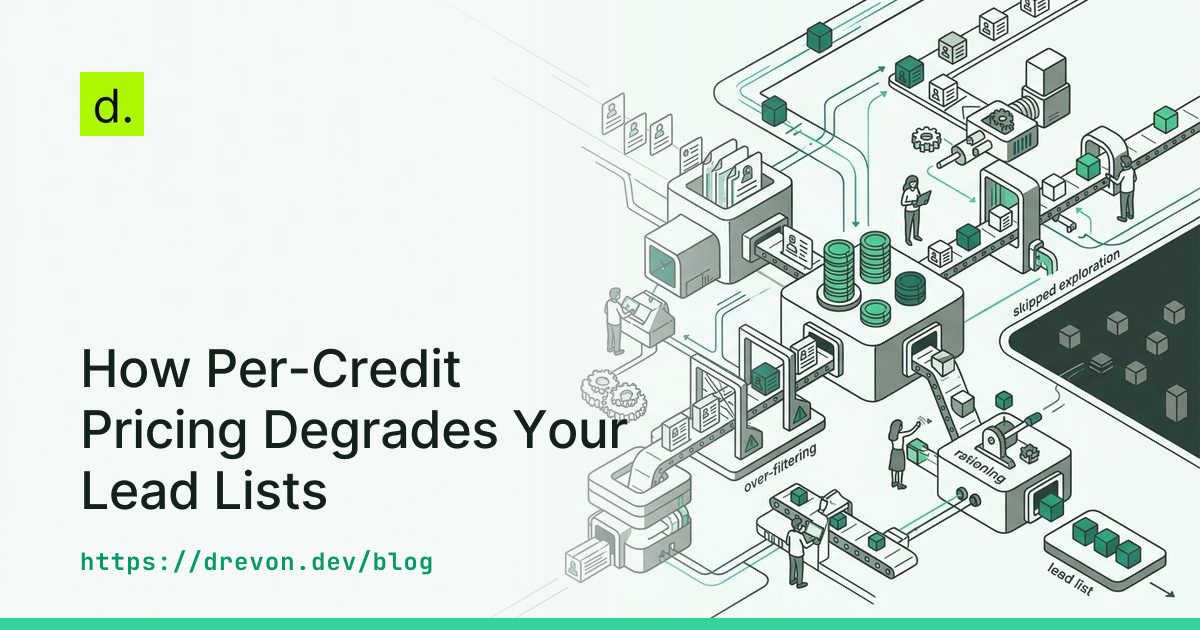
This anxiety leads to a specific, counterproductive behavior: premature optimization. Users apply hyper-specific, multi-layered filters from the very first search. They try to build the perfect query on the first attempt to avoid paying for imperfect leads. This fundamentally misunderstands how good research works. Discovery requires broad exploration followed by iterative refinement, a process that credit models directly penalize through what behavioral economists call the “taximeter effect,” where every action has a visible, accumulating cost.

Why Over-Filtering Leads to Worse Results
Overly narrow searches generate small, homogenous lists. They deliver the most obvious leads—the “head” of the demand curve—but miss the higher-intent opportunities in the long tail. As first described by Chris Anderson in 2004, the long tail consists of a large number of niche opportunities whose collective value can exceed that of the few popular “hits.”
For example, a search for ‘VP of Marketing at Series B SaaS companies using Marketo’ is too rigid. It is a predictable query that generates a list identical to your competitors'. It misses the ‘Head of Growth’ at a Series A company who just posted on Reddit about their Marketo implementation frustrations. This is the kind of intent-driven lead that converts at a rate two to three times higher than traditional leads, but finding it requires experimentation.
Credit anxiety stifles this kind of creative, cross-platform exploration. On some platforms, revealing a single phone number can consume 10 credits, and overage costs can reach $0.60 per contact. At that price, experimentation feels reckless. The result is a list that looks correct on the surface but lacks the unique signals that actually convert. You find the leads everyone else finds.

An Alternative: Pricing for Exploration
Our model is different. We built Drevon to execute research tasks, not to sell rows of data. This removes the friction of per-credit costs and the anxiety that comes with them.
This structure encourages a better workflow. You can start with a broad query to understand the landscape, analyze the initial results, and then run subsequent tasks to refine your search based on what you learn. Instead of spending an hour trying to build one perfect, restrictive query, our users can run multiple variations in minutes to compare different market segments.
This method requires more judgment from the user. The goal is not to produce a flawless list on the first try, but to provide the tools for effective discovery. By removing the penalty for exploration, we enable a process that more closely resembles how human experts work: by learning and iterating.

A Pricing Model Is a Product Feature
A tool’s business model directly influences how it is used. A model that meters access to individual results is a bug, not a feature, because it discourages the deep work necessary for high-quality output. This misalignment is why some of the largest data platforms, like New Relic and Splunk, have moved away from pricing models that penalize usage and toward models that align cost with value.
The goal of a growth platform should be to maximize discovery, not to count database lookups. When evaluating a tool, consider how its pricing will shape your team’s research habits. The hidden cost of a credit model is the opportunities you never find.