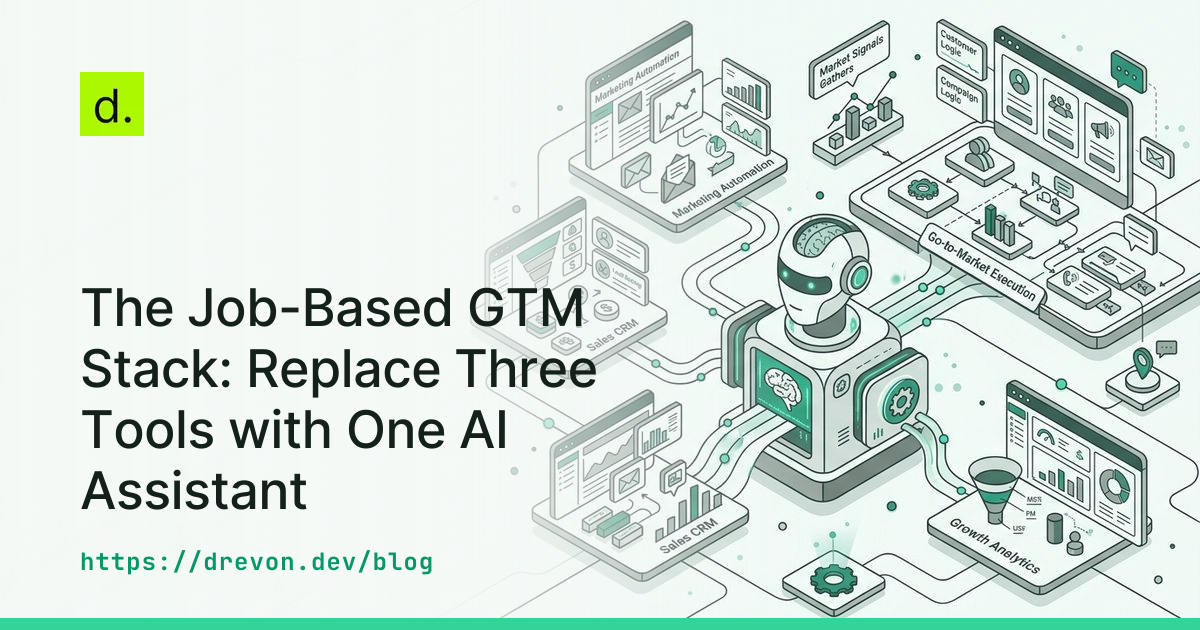
The Job-Based GTM Stack: Replace Three Tools with One AI Assistant
Most go-to-market stacks are built by tool category, not by function. We propose a different approach: defining the job to be done, then using an AI assistant to execute it on public data, replacing multiple expensive subscriptions.
Go-to-market teams operate with a sprawling set of tools. The average organization uses about 75 different martech tools, with some enterprise marketing departments using over 120. This happens because teams buy point solutions for narrow functions: one for intent data, another for contact information, a third for competitive intelligence.
The annual cost for these platforms is substantial. A mid-market company can expect to pay between $60,000 and $130,000 per year for a revenue intelligence platform like 6sense, according to an analysis of 381 deals by procurement platform Vendr. A data provider like ZoomInfo adds another $30,000 to $60,000, and an intent data tool like Bombora can add $50,000 to $100,000. These contracts often require multi-year commitments.
The total cost, however, is not just the sticker price. It includes the hidden tax of context switching. Toggling between applications consumes up to 40% of a knowledge worker's productive time. This constant shifting fragments attention and degrades focus. Research from UC Irvine shows it takes over 23 minutes to fully return to a task after an interruption. This lost productivity costs the U.S. economy an estimated $450 billion annually.

A First-Principles Approach: Focus on the Job, Not the Tool
We propose a different framework for building a GTM stack, based on Clayton Christensen's 'Jobs to Be Done' theory. The theory posits that customers do not buy products; they "hire" them to make progress in a specific circumstance. According to the Christensen Institute, a 'job' is the progress a person is trying to make. This shifts the focus from a tool's features to the outcome it enables.
Instead of buying a category of tool, such as 'an intent data platform,' we define the specific job to accomplish. For example: 'Find 10 companies that just hired a VP of Engineering and are complaining about their current CI/CD pipeline on Reddit.' The four core GTM research jobs can be defined as:
- Identifying your Ideal Customer Profile (ICP).
- Finding prospects that fit the ICP.
- Uncovering buying signals that indicate intent.
- Gathering competitive intelligence.

Executing the Core GTM Jobs with a Lean Stack
Much of the data needed to perform these jobs is public. The challenge is not access but the manual labor required to collect and synthesize it. By focusing on the job, we can use public sources to replace single-purpose tools.
Job 1: Finding Prospects
Instead of relying exclusively on a dedicated data provider, we can use public signals from LinkedIn, company job boards, and industry news. A company hiring for a specific role, like an 'HR Manager,' is a strong signal of need for HR software. One SaaS company used this exact strategy with LinkedIn Job Alerts to increase its qualified leads by 30% in three months.
Job 2: Uncovering Buying Signals
Instead of a specialized intent tool, we can monitor public forums where buyers conduct research. According to Forrester, 57% of enterprise buyers rely more on communities and peers than on vendor content. On Reddit, 77% of B2B buyers seek out testimonials during their research, according to a 2026 study by SurveyMonkey and Reddit. Cybersecurity firm Huntress used Reddit to engage with IT decision-makers, converting 40% of sales-qualified accounts from the platform into opportunities.
Job 3: Gathering Competitive Intelligence
Instead of a platform that tracks competitors, we can monitor their public activity. Hiring trends on LinkedIn reveal strategic priorities. New customer announcements signal market traction. User reviews on G2 or Capterra expose product weaknesses and customer pain points that can inform our own messaging and sales outreach.
The Consolidation Layer: An AI Assistant for Research
Relying on public data has its limitations. The data is often unstructured, and B2B data decays at a rate of about 22.5% per year as people change jobs. Manually collecting and verifying this information is the primary bottleneck.
An AI research assistant can serve as the consolidation layer for this work. It automates the manual labor of browsing disparate sources, extracting relevant information, and synthesizing it into a usable format. Instead of logging into three separate tools and manually cross-referencing data, we can give a single, plain-English instruction:
Find me 20 companies that use HubSpot, recently posted on Reddit about needing better analytics, and are currently hiring for a data analyst role.
This approach replaces multiple subscriptions with a single, flexible interface that performs the underlying jobs. It consolidates the function, not just the data, into one workflow.

How to Consolidate Your Stack
You can begin by auditing your current tools. For each subscription, write down the specific 'job' it performs. Identify the overlaps and single-purpose platforms that could be replaced by a more direct research process on public data. This shifts the focus from managing tools to getting results, letting you execute complex research with a single instruction. You can then begin to consolidate these workflows using a tool designed to automate that research process.